Showing posts with label configure. Show all posts
Showing posts with label configure. Show all posts
Saturday, December 31, 2016
Configure Qt5 Application Style Icons Fonts And More With Qt5ct
Configure Qt5 Application Style Icons Fonts And More With Qt5ct
Unlike Qt4, Qt5 doesnt come with a configuration tool to allow setting the icon theme, fonts or the style and instead, it tries to use the settings from the running desktop environment.
This works well for KDE and GNOME (as well as Unity) but you may encounter issues under other desktop environments such as Xfce, Cinnamon, MATE and others (Im not sure what Qt5 versions are affected by this, but it seems to be fixed in the latest Qt 5.5.1 according to THIS comment).
Heres an example (Audacious 3.7 using the Qt5 interface under Linux Mint 17.2 with Cinnamon):
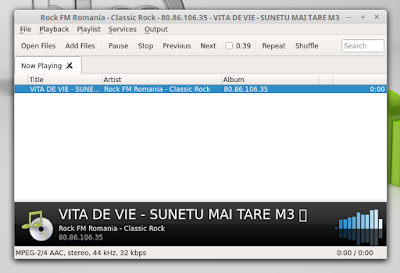
Instead of "Open Files", "Add Files" and so on, Audacious should have icons. The app is also not using the GTK+ Qt5 style.
To force the Qt5 style or icon theme, you can use an application called Qt5ct (Qt5 Configuration Tool). Besides the style and icons, Qt5ct can also be used to change various other Qt5 settings, such as fonts, add custom style sheets and tweak other interface settings such as the double click interval, enable icons in menus and dialog buttons and more:
To force the Qt5 style or icon theme, you can use an application called Qt5ct (Qt5 Configuration Tool). Besides the style and icons, Qt5ct can also be used to change various other Qt5 settings, such as fonts, add custom style sheets and tweak other interface settings such as the double click interval, enable icons in menus and dialog buttons and more:
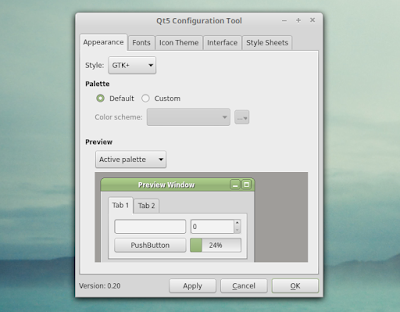
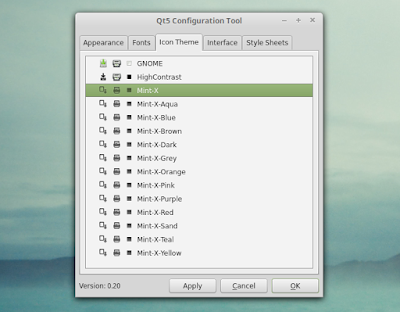
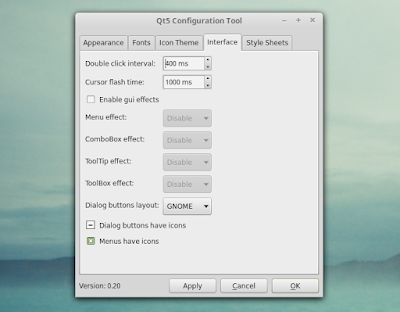
Heres another Audacious 3.7 Qt5 interface screenshot taken under Linux Mint 17.2 Cinnamon, after using Qt5 Configuration Tool to set the icon theme to Mint-X and the style to GTK+:
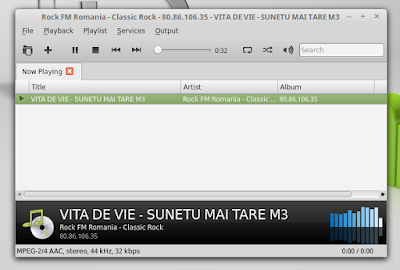
To make it easier to install Qt5ct for Ubuntu and Linux Mint (and derivatives) users, Ive uploaded the latest version in the main WebUpd8 PPA. I didnt package the application and instead, Ive used the packaging from THIS PPA. I decided rebuild the packages because that PPA comes with an older version and the packages are only tested for Ubuntu 14.04 (and in my test, the Ubuntu 15.04 and 15.10 packages werent installable). So the packaging credits go to "hda_launchpad".
Install and configure Qt5 Configuration Tool in Ubuntu or Linux Mint
1. To add the main WebUpd8 PPA and install the latest Qt5 Configuration Tool (Qt5ct) in Ubuntu 16.04, 15.10, 15.04 or 14.04 / Linux Mint 18 or 17.x and derivatives, use the following commands:
sudo add-apt-repository ppa:nilarimogard/webupd8
sudo apt-get update
sudo apt-get install qt5ct
If you dont want to add the PPA, you can download the DEB from HERE (but you wont receive any updates unless you add the PPA).
Arch Linux users can install Qt5ct from the Community repository. For other Linux distributions, you can download Qt5ct from SourceForge.
2. Once installed, theres one more step you need to follow or else the settings you apply using Qt5ct wont be applied - you need to open ~/.profile with a text editor (".profile" is a hidden file in your home directory so use CTRL + H to show hidden files) and at the bottom of this file, add the following line:
export QT_QPA_PLATFORMTHEME="qt5ct"Then, save the file, log out and after you login you can use Qt5 Configuration Tool to change the Qt5 style, icon theme and so on.
Youll need to restart any Qt5 applications that were running to see the changes.
If later on you want to revert the changes, simply remove the "export QT_QPA_PLATFORMTHEME=qt5ct" line from your ~/.profile file and restart your session (logout).
Notes:
If later on you want to revert the changes, simply remove the "export QT_QPA_PLATFORMTHEME=qt5ct" line from your ~/.profile file and restart your session (logout).
Notes:
- Ive tried adding this in Lubuntu 15.10 (uses LXDE) to ~/.profile, ~/.xsessionrc as well as /etc/environment and it didnt work for some reason (but exporting it using a terminal and then running a Qt5 app works, so the Qt5ct application works properly). If you find a way to get this to work in Lubuntu, let us know in the comments!
- Using Qt5ct breaks the `Albert` user interface (probably because Albert tries to use the theme specified by Qt5ct).
via Arch Wiki

Go to link Download

Monday, October 31, 2016
Configure Razer Mice In Linux With Razercfg Ubuntu PPA
Configure Razer Mice In Linux With Razercfg Ubuntu PPA
Razer Synapse, the official Razer configuration utility, doesnt work on Linux however, theres a tool called Razercfg that allows configuring some of the Razer mice settings under Linux.

The application only includes options that are supported by the mouse hardware, like changing the DPI, scan frequency (polling rate) and led colors. So for instance if the hardware doesnt support button remapping, Razercfg wont offer this option. That also means that Razercfg doesnt support macros.
Razercfg also allows saving and easily switching between profiles (Desktop, FPS gaming, RPG gaming, etc.).
The latest stable Razercfg doesnt ship with a tray applet / AppIndicator, though such a feature should be added in the next release (0.34), and youll be able to use it to quickly switch between profiles.
Razercfg supports the following devices:
- Razer DeathAdder Classic
- Razer DeathAdder 3500 DPI
- Razer DeathAdder Black Edition
- Razer DeathAdder 2013
- Razer DeathAdder Chroma
- Razer Krait
- Razer Lachesis Classic
- Razer Naga Classic mouse
- Razer Naga 2012 mouse
- Razer Naga 2014 mouse
- Razer Naga Hex mouse
- Razer Taipan mouse
The following mice are listed as stable, but missing minor features:
- Razer Boomslang CE
- Razer Copperhead
- Razer Lachesis Classic
For a complete list of hardware features for each mouse, see the Razercfg homepage.
I also managed to add basic support for Razer Ouroboros mice (for both wired and wireless modes), based on this bug report, by using the Taipan code as a base (only basic features: enable/disable the leds and change the DPI and scan frequency). This is available if you use the packages available in the main WebUpd8 PPA or by downloading the Debian packaging (youll find the patch in the debian/patch folder).
Dont report bugs related to the Ouroboros on the Razercfg GitHub page since the app doesnt officially support it yet.
Install Razercfg in Ubuntu
Note that I only tested the packages in Ubuntu 16.04, which uses systemd, so Im not sure if it will work in Ubuntu 14.04.
Razercfg is available in the main WebUpd8 PPA, for Ubuntu 16.04, 15.10, 15.04 and 14.04. Add the PPA and install the application using the following commands:
sudo add-apt-repository ppa:nilarimogard/webupd8
sudo apt update
sudo apt install razercfgIf the application doesnt detect your mouse (and the device is listed as supported), try restarting the system and also see the first note below.
Important:
- if your system has an xorg.conf file (/etc/X11/xorg.conf), youll need to make sure it doesnt specify a device (you can comment out the "Device" section) or configure it to use a generic device. The Razercfg GitHub page explains this in detail;
- if the settings are not saved between system restarts, you can edit the /etc/razer.conf configuration file to specify various options and initial hardware configuration settings.
For other Linux distributions, see the Razercfg GitHub page.
Also see: How To Change The Mouse Scroll Wheel Speed In Linux Using imwheel.
Go to link Download
Subscribe to:
Posts (Atom)